The right choice of exercise for prosthesis wearers
When I started training, I actually only did exercises on the machine. I’d still do that for the most part now. Machines are perfect for setting up a mind-muscle connection. That means nothing other than that you can consciously tense and feel a muscle. Now it is the case that some machines are operated with both hands at the same time and therefore both halves of the body have to work together. The problem here is the efficiency of our body because instead of the weaker side getting tired first, the stronger side will work harder and take over more load compared to the weaker side. If you have developed a good muscle feeling, you can counteract this quite well by focusing more on the weaker side. If this is not mastered, imbalances are pre-programmed and the stronger side becomes stronger and stronger, while the weaker side experiences only minimal growth (from personal experience). Therefore, as a prosthesis wearer today, I would use unilateral machines, i. e. machines on which both sides are trained independently of each other, as far as possible from the outset in order to counteract imbalances as best as possible. In the beginning, for example, I had always trained the chest with bilateral exercises and was quickly able to see that my otherwise strong right chest gained muscle mass much faster than my left chest. It was only when I incorporated single-arm bench press and cable pulls (see videos) into the training that I was able to almost compensate for this difference.
Also, I hesitated too long with more complex exercises like free barbell exercises because I always thought I wasn’t that far yet and I had seen too many „fail videos“ on Youtube 🙂 Now I know that these exercises are not easy to learn anyway, no matter how long you train on machines. The fact is that it is precisely these exercises that bring the most success.
I will show here some of my favorite exercises, which I would like to share with you. The videos I have not shot without reason with a naked upper body, because I think the most important thing is my posture during the exercise and you see it not really with a T-shirt on. I not a professional and therefore cannot guarantee that I will perform every single exercise perfectly. Please keep this in mind.
I would like to thank the Local fit team very much because they gave me permission to shoot the videos in their gym in Bremgarten and supported my idea from the beginning. I have been training there for over 2 years now and find not only the atmosphere super great and motivating but also like the equipment, which is top modern and well maintained.
Warming up and strengthening the rotator cuff
The rotator cuff consists of 4 muscles, which serve for the stabilization of the humerus. They hold the joint head in the socket. In strength training, however, we usually train only the inner rotation, which is why the outer rotation is usually not active enough or is not well developed enough to stabilize the joint under heavy loads. It can happen that the space for the tendons above becomes too narrow and the tendons become trapped under strain. In the long term, this can lead to inflammation and severely damage the tendon insertions.
To avoid this I always train the external rotation before my chest training to strengthen these muscles. I do the two exercises listed above one after the other and a total of 3 times per arm with 6-8 repetitions per set.
Hints for the first exercise:
During the first exercise, the elbow should always lie against the body and the rotation should come from the upper arm. If the exercise is performed correctly, a slightly uncomfortable pull on the shoulder blade should occur. Better start with very little weight but do the exercise correctly!
Hints for the second exercise:
In the second exercise, the humerus should always be aligned parallel to the floor. Otherwise, the stronger upper neck takes over the function. If the exercise is performed correctly, a slightly uncomfortable pull on the shoulder blade should occur.
lat-pulldown variants
Since the strengthening of the back muscles contributes a lot to the improvement of the incorrect posture, it should also be given a lot of attention.
Hints for both exercises:
With lat pulldown, it is important to keep the shoulders down during the whole movement and to keep the tension. It can be helpful to film yourself doing the execution to see what the posture is like. In the beginning, a correct posture will feel strange and this feeling can be remembered. This way you know at which feeling the shoulders are correctly aligned. Over time, however, this becomes an automatism.
I do this exercise with moderate weight with repetitions between 10 and 12 and 3 sets each to really feel the latissimus and contract it completely at the end of the movement. A good approach how far to pull the bar is the chin height. However, this depends strongly on the anatomy of the person. Care should be taken that the shoulders do not rotate at the end of the movement, otherwise strong forces act on the rotator cuff.
Rowing variants for the middle and upper back
Rowing exercises are excellent for the development of the middle and upper back, as they hit the middle trapeze, the rhomboid, the latissimus and the rear delt.
Hints for both exercises
The elbow should be moved as close as possible to the body, otherwise, the weight practically only rests on the rear delt and the latissimus is not activated at all. It can also help to imagine pulling with the elbow instead of the hand, so the activity of the biceps is minimized. In both exercises, it is important to contract the shoulder blades at the end of the movement to achieve maximum activation.
The weight should be selected in such a way that the design can be carried out without momentum. I remain here in the repetition range of 8-10 with 4 sets each.
Bench press at the multipress, chest press and flying at the cable pull
Building a symmetrical chest with a prosthesis is not easy. Many pressing movements also involve other muscles such as biceps, triceps and the front shoulder, so all muscles must be trained to achieve optimal performance. At the moment I am testing the variant that I start with bench presses and incline bench presses and with the chest press, I train only the left chest until muscle failure. Then I do flys at the cable pull to isolate the chest. This system seems to work quite well because the difference in size from my left to my right chest is small and improving steadily.
Hints for the first exercise:
To protect the shoulder, a light hollow back is recommended to change the angle of the chest. Movement with a prosthesis may be slightly restricted but not problematic. I recommend this exercise only if a good mind-muscle connection is present. The rotator cuff should be warmed up well before each chest workout to prevent injuries! The forearms should be placed vertically under the bar and at an angle of about 45° to the body down to the chest. With good mobility, the bar touches the breast approximately on nipple-height. I usually make 4 sets of 6-8 repetitions.
Hints for the second exercise:
In principle, the same procedure can be used for bench pressing. With an angle less than 45° to the body, the triceps can be put under more strain, so you can play a little with the angles and draw the last strength from the chest. I usually make 3 sets of 8-10 repetitions.
Hints for the third exercise:
When flying at the cable pull, a slight stretch of the chest should be noticeable in the starting position. This is achieved with one step forward and the contraction of the shoulder blades. The shoulder blades should remain in the back during the entire movement so that the front delt does not take over the entire load. Important: Since the lever arm on my left side is shorter, I have to move more weight to get the same effort. I usually make 4 sets of 10-15 repetitions and pull sometimes from below and sometimes from above.
Hanging leg lift for the abdominal muscles
Abdominal muscles are not only visually appealing they also fulfill an important function, namely the stabilization of the trunk. Furthermore, in many people, the hip flexors are shortened by sitting for long periods and the abdominal muscles are too weak, resulting in a malpositioning of the pelvis and a so-called hollow back.
Hints for the exercise:
This exercise is rather unsuitable for beginners since it already requires a lot of strength. I slowly worked my way up to this exercise by doing the frequent abdominal exercises on the floor with weights and slowly increasing the weight. Absolutely essential in this exercise is the rolling of the pelvis at the end of the movement, as otherwise only the hip flexors are loaded. As an easier alternative, the legs can be angled and the knees pulled upwards. Swinging is not allowed at any time, so you should tighten your whole body. I usually do 2-3 sets of about 10 repetitions until total exhaustion of the abdominal muscles. Then I do at least one exercise for the lateral abdominal muscles and another exercise for the abdominal muscles.
Deadlift
If the residual limb is not too sensitive and the hold in the prosthesis is good, I am a fan of deadlifting. In this exercise, almost the entire rear musculature is involved, from the rear thighs to the back. The back extensor, the opponent of the abdominal muscles, is also very well stimulated by this exercise to grow.
Hints for the exercise:
The bar should be above the middle of the feet and the knees should be turned slightly outwards. The back MUST remain straight when the back forms a hump the weight is too high and the lower back is exposed to immense forces. Before pulling up, the lat should be tensioned and the chest stretched out, and a trunk tension should be built up. The bar should always be moved as close to the body as possible during an upward movement to keep the center of gravity close to the body. At the beginning, I made 4 sets of 6-8 repetitions. For a detailed description, you should consult other sources for help.
Side lateral raises on the cable pull
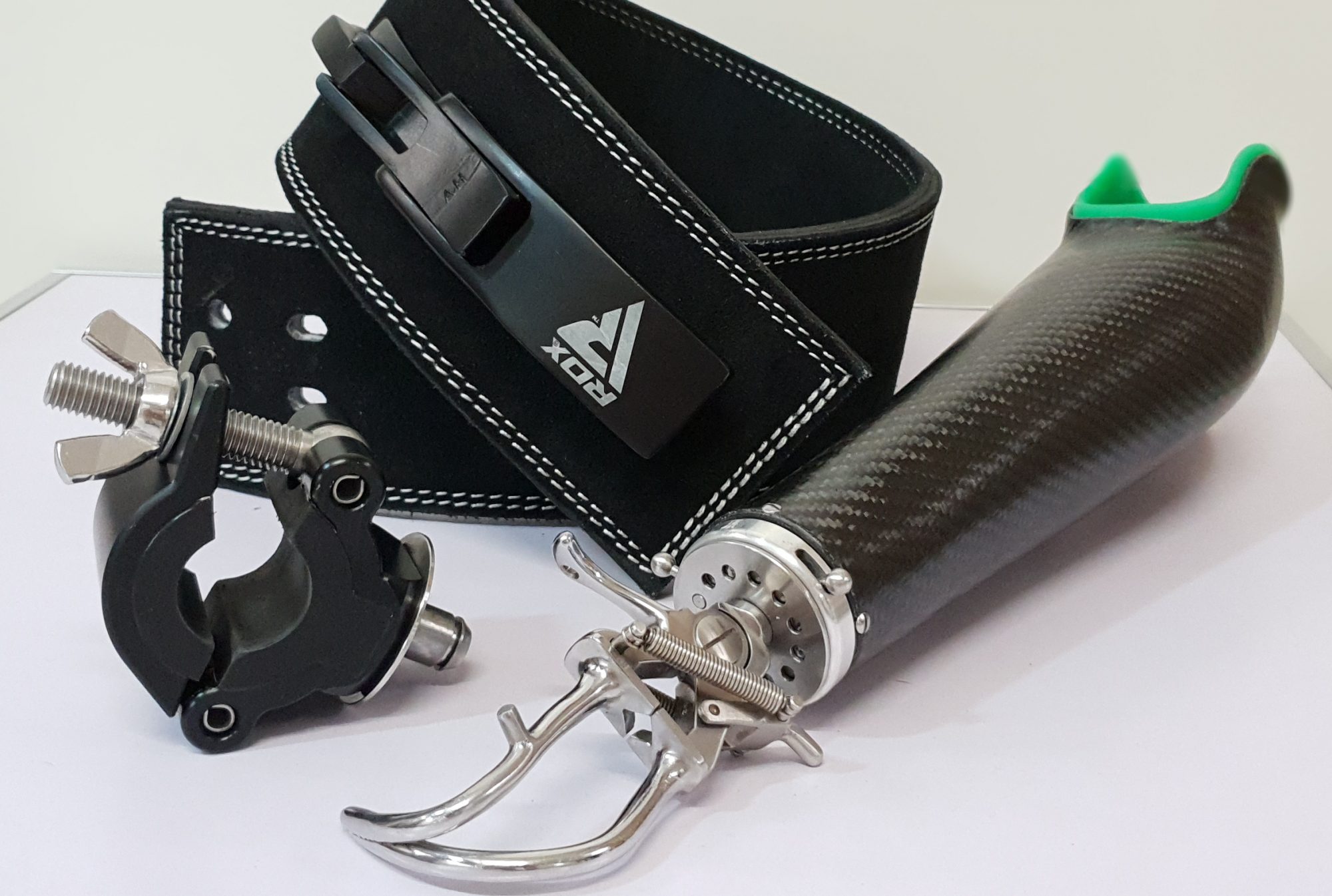
With one of the best exercises to train the lateral shoulder. I use a gipping hook (available in every fitness shop) because I have more stability than with the prosthesis.
Hints for the exercise:
The arm should not be pulled much higher than parallel to the shoulders, otherwise, the upper neck takes over the load. I usually make 4 sets of 8-10 repetitions.
Overhead triceps extension
This exercise is great for hitting the lateral triceps optimally. The inner head can be trained with triceps kickbacks. A longer residual limb would, of course, allow for further triceps exercises, but a shorter residual limb would make some exercises difficult.
Hints for the exercise:
The upper arm should be as vertical as possible to the ground. At the end of the movement, a good stretch of the tricep should be noticeable. With the other hand, the movement can be stabilized but the weight should be moved by the prosthesis alone.
 fuctionalprostheticsENG